
Case study · Deck & dock builder
Galveston Deck Builder: Decks, Docks, Fencing and Pergolas, Without Doorway Pages
A Galveston builder’s recent WordPress site had the services but not the structure. We rebuilt it as 61 pages Google should index, 45 it deliberately shouldn’t, and every old address redirected in one hop.
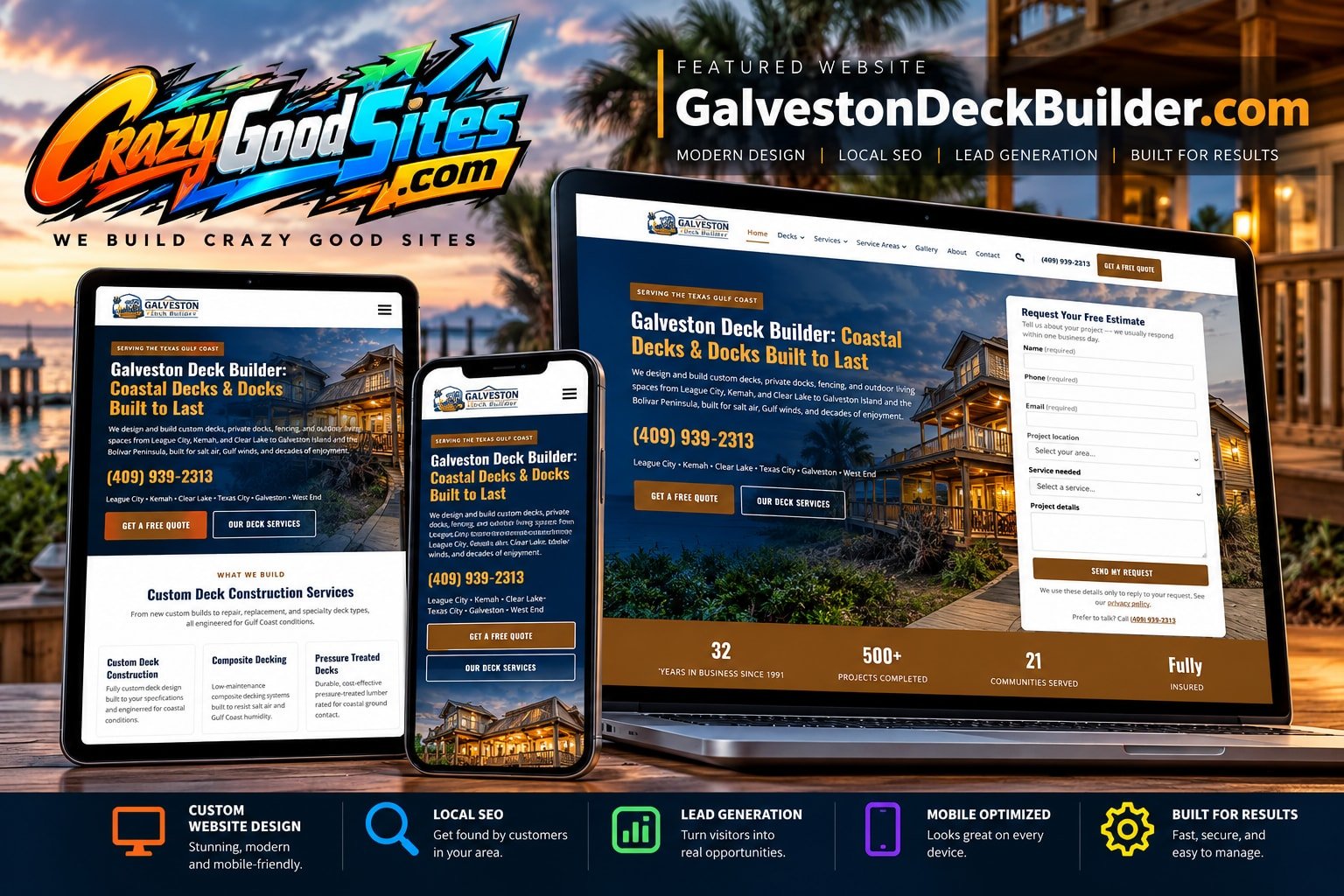
At a glance
GalvestonDeckBuilder.com
- Business: Galveston Deck Builder — coastal decks and docks, plus fencing and pergolas, in Galveston, Texas
- Launched: September 15, 2026, replacing the WordPress site on the same domain and host
- Size: 106 pages in all: 61 for Google to index and 45 supporting pages kept out of the index on purpose
- Structure: a page per deck service, pillar pages for docks, fencing and pergolas, and 17 service-area pages for the places the company builds
- Lead capture: a quote form that works with JavaScript switched off, sent from the site’s own mailbox over authenticated SMTP and logged on the server first
Where they started
Galveston Deck Builder already had a live WordPress site, and a fairly recent one. The problem wasn’t age; it was shape. Every service sat at a flat address off the home page, so there was no way to tell Google which pages were about decks, which about docks, and which about the places the company builds in. The only logo was a small image with an opaque white background. And like most WordPress sites of its kind, it carried the weight of a theme, a page builder and plugins for a business whose website has one job: get a homeowner on the island to ask for a quote.
What we had to work with
- The old site’s sitemaps. Every address was exported before anything else, and 29 of them were mapped to their new homes, each with a single-hop redirect tested before launch.
- No Search Console access. We couldn’t see which old pages had traffic, so the redirect map treated every address as worth keeping.
- The owner’s services and areas. The deck work the company does, the dock, fencing and pergola work alongside it, and the parts of the island and the bay area it actually serves.
What we built
- A clear hierarchy. Deck services live under /decks/ — custom deck construction, composite decking, pressure-treated and cedar decks, pool decks, elevated coastal decks, covered decks, deck repair, replacement, stairs and railings. Docks, fencing and pergolas each get a pillar page of their own. Service areas live under /locations/, one page for each of the 17 areas the company builds in.
- 106 pages, 61 of them indexable. Forty-five supporting pages — the dock, fence and pergola pages for each area — are live and linked from the area pages for visitors, but marked so that Google does not index them. One strong page per area instead of four thin ones.
- Claims the owner could stand behind, and only those. “Backed by our workmanship guarantee” came out of 51 pages, because there is no written warranty. A line claiming regular work in each area came out of the 17 area pages and the About page was rewritten, because nobody could show it was true for every area.
- Every main page written at full length, with the content a buyer on the coast actually needs: salt air, storm exposure, elevated construction, materials that last.
- Breadcrumbs on every inner page, in the page and in the structured data, plus an HTML sitemap in the footer and a site search.
- A header that works on a phone: the menu becomes a drawer below 1280 px, and keyboard focus stays inside it while it is open.
- The quote form. It submits without JavaScript (the script only prevents a double send), carries a session-based token against replay and bots, saves every request on the server before mailing it, and sends from a mailbox that belongs to the website’s own domain — so any consequence of form abuse lands on a single-purpose mailbox, never on the owner’s everyday email.
- Self-hosted fonts, so the privacy policy can truthfully say that no font provider sees the company’s visitors.
- Old addresses handled. 29 WordPress URLs redirect in one hop; the before-and-after page points to the gallery because no before-and-after pairs exist; the empty blog is kept out of the index and the navigation until there is something in it.
- Tested like an attacker. Before launch the form was run through the full attack suite — forged submissions, replays, floods — and the mail headers were checked on real deliveries.
Why it is built this way
Index only what deserves it
It is easy to generate a page for every service in every town; it is also the fastest way to teach Google that a site is thin. Keeping 45 near-duplicate pages out of the index — while still letting a visitor reach them — gives each area one page that can rank, and keeps the site’s reputation on the pages that earn it.
One hop, decided once
The canonical form of every address — https, no www, no file extension, no trailing slash — was settled before the first page was built and enforced everywhere, so there are no redirect chains and no duplicate addresses for Google to choose between.
Claims are liabilities
A guarantee that exists only as a sentence on a web page is a promise the owner never made. Removing it from 51 pages cost nothing and removed a risk.
A form that cannot fail quietly
Most lost leads are never noticed. Saving every request on the server before mailing it, sending from the site’s own mailbox, and reading the delivered message’s headers on launch day are how we know the form works — not a green “sent” message.
Built on the standard we use for every site
Mobile first, structured data for the business and its services, a fast first paint, accessibility built in. The decisions specific to this site were the hierarchy, the index rules and the claim review.
What is measurable today
- 61 indexable pages live on the company’s domain, 45 supporting pages reachable but unindexed, 29 old addresses redirecting in one hop.
- The form proven on the live host: the attack suite passed, and delivery was confirmed by reading real message headers.
- Search Console is the owner’s next step; the sitemap lists only the 61 pages meant for the index.
What we don’t publish: traffic, rankings and lead counts. They belong to the business. If the owner agrees to share measured figures later, they will appear here with the date and the source.
Keep reading
Want one like this?
Read the deck builders website guide, see all our work, or see every price. Lease a website from $199 a month with nothing up front, or buy one — Starter from $599, Standard $1,199 — with all the page content written for you and a payment plan with no interest.

Ready for a crazy good site?
Want a site like Galveston Deck Builder’s? Call Tab — you’ll get a straight answer and a quote.
Calls answered Mon–Sat, 7 AM–10 PM Central