
Case study · Home builder & contractor
Onalaska Builders: Ten Trades, One Site That Explains Them All
A builder with its own crews, a 35-mile territory around Lake Livingston and a stopgap WordPress site full of demo text. Here is what we replaced it with, and why it is built the way it is.
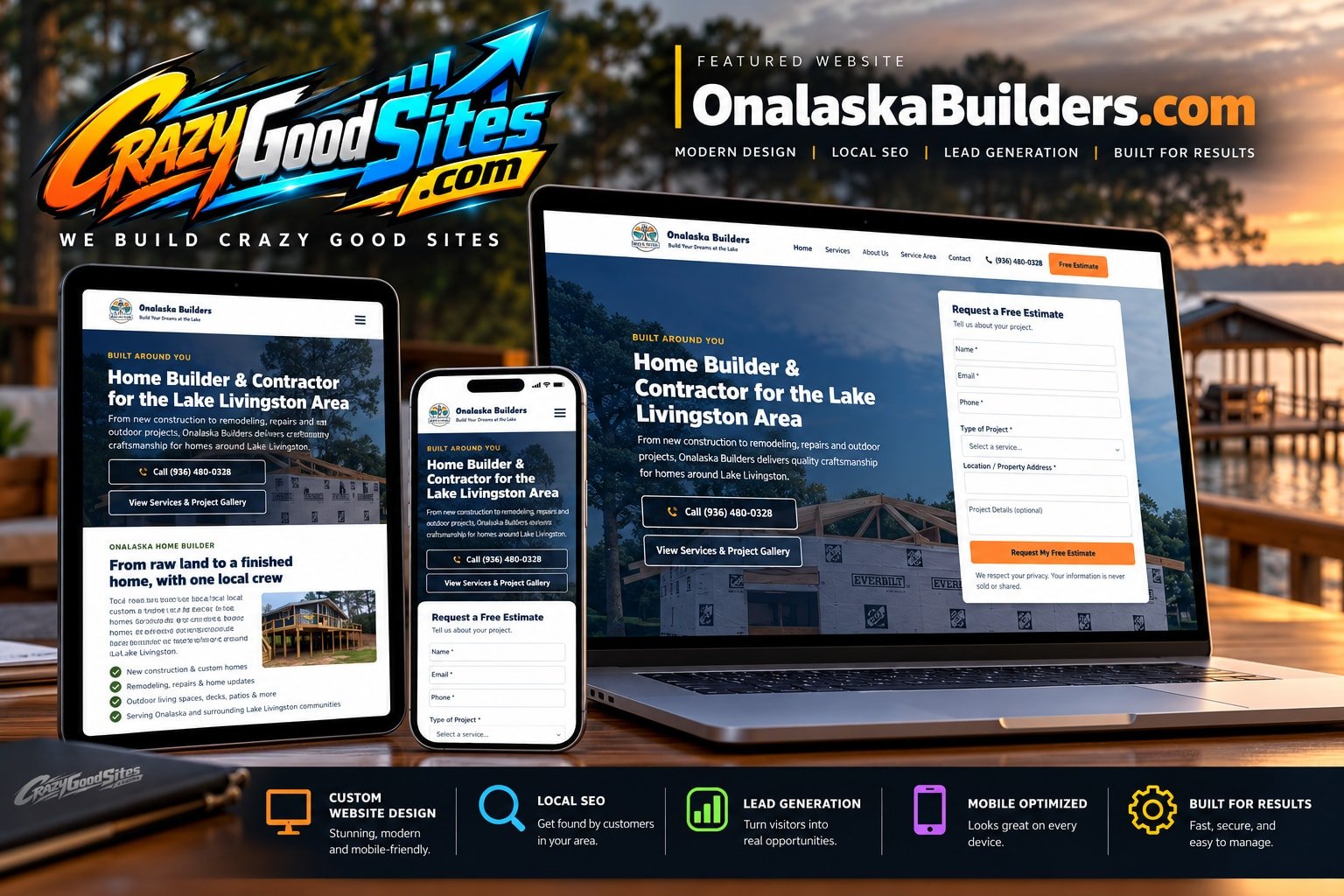
At a glance
OnalaskaBuilders.com
- Business: Onalaska Builders — a home builder, remodeler and handyman service that does the work with its own crews, based in Onalaska, Texas
- Launched: September 17, 2026, on the same domain, replacing the old site in place
- Size: 68 pages: ten trade sections with 47 service pages, plus projects, gallery, service area, about and contact
- Content: every word written from the owner’s facts and approved by him; 253 question-and-answer pairs across the site
- Lead capture: click-to-call on every page and one estimate form, reachable at the top and the bottom of every service page
- Photos: more than 120 of the owner’s own job photos, encoded in three formats at the sizes the layout needs
Where they started
When we first opened onalaskabuilders.com in September 2026 it was a WordPress site on a stock theme, put up as a stopgap. The About, Services, Projects and Contact pages still carried the theme’s demo text. The Contact page showed a demo address and phone number that weren’t the company’s. There were three demo blog posts and a set of checkout pages left behind by a shopping plugin the business had never used. The site called the company “Onalaska Custom Homes” in its title and footer and “Onalaska Builders” in the body.
The real business does far more than custom homes. The crews clear land and build house pads, pour foundations, frame new homes, garages and sheds, remodel kitchens and bathrooms, handle repairs and handyman jobs, mow and landscape, and build docks, boathouses and bulkheads on Lake Livingston. None of that was on the old site, and the owner wanted the new one to cover all of it across a wider area than before.
What we had to work with
- The owner’s answers. Services, the places served, hours, how soon jobs usually start, what the crews do and don’t do. Every fact on the site traces back to one of them.
- The old site’s addresses. We pulled every URL from its sitemaps so that nothing anyone had linked or Google had indexed would dead-end after the switch.
- His photos. Two batches of real job photos — boathouses, docks, bulkheads, decks, land clearing, lawn work, repairs — reviewed one by one before any went on a page.
What we built
The structure is the point. A homeowner searching for a boathouse builder or for foundation repair near Livingston doesn’t type “contractor”, so the site gives each trade its own section and each service its own page.
- Ten trade sections, 47 service pages. Dirt work and land clearing, foundations, new home construction, garages and outbuildings, remodeling, home repair and carpentry, handyman services, outdoor living and yard care, roofing and exterior repair, and docks and marine construction. Each section has a hub page with its services one level below it, so a visitor is never more than two clicks from the page that answers their question.
- One honest service-area page. The 24 communities within about 35 miles of Onalaska, across Polk, San Jacinto, Trinity and Walker counties plus Cleveland and Willis, listed with distances measured from the town centre, not guessed. One page instead of 24 near-identical town pages.
- Content written from the owner’s facts. Hours, typical start times (“most projects start within about one to three weeks”), what the crews handle themselves. Anything he hadn’t confirmed — prices, licences, warranties, permit handling — is either hedged or left out.
- 253 questions and answers. Every service page and hub carries its own FAQ, each answer under 60 words, with 115 question-style headings on top of that. They are written for people first and, because of that, work as spoken and AI answers too.
- Projects and a gallery from his photos. 123 job photos, encoded to AVIF, WebP and JPEG at the widths each slot actually needs, with real descriptions of what each one shows.
- One estimate form, two entry points. Name, phone, project type, town or ZIP and details — nothing more — at the top and bottom of every service page, with five layers of spam protection, every request saved on the server before it is emailed, and a consent line under the button.
- Every old address handled. 36 redirect rules send the WordPress-era URLs — including the demo posts and the checkout pages — to the right new page, or answer “gone” where there is no equivalent.
- The technical layer. Structured data for the business, every service, the breadcrumbs and every FAQ; business hours in the footer and in the data Google reads; Google Analytics with a conversion event that fires only after a real request; mobile-first layout; the stylesheet delivered inside each page so the first paint doesn’t wait on a second request; built to the WCAG 2.2 AA accessibility standard.
Why it is built this way
A page for each service
Google matches a search to a page, not to a business. A bulkhead page can rank for bulkheads; a “Services” page that mentions bulkheads in a list cannot. The same page also does the selling: it answers the questions a lakefront owner actually has before they call.
One service-area page, not 24
Town pages that differ only by the town name are what Google calls doorway pages, and it filters them. Twenty-four communities with real distances on one page say the same thing truthfully, and the page earns its place by being useful: it is where a visitor checks whether Onalaska Builders comes to them.
Nothing invented
The site has no “licensed and insured” badge, no starting prices and no founding year, because the owner hadn’t confirmed them when it launched. A visible gap is better than a plausible claim; a claim that turns out to be wrong costs the business its credibility and can cost it legally.
Redirects before launch, not after
A replacement site that drops the old addresses throws away whatever the old pages had earned and sends every old link to an error page. Mapping them is a day of work that protects months of history.
Built on the standard we use for every site
The same build rules apply to Onalaska Builders as to every site we make: the content written for the owner from his facts, mobile first, structured data, a protected form, a fast first paint and accessibility built in rather than bolted on. The difference between sites is the business, not the quality of the build.
What is measurable today
- 65 pages in the sitemap Google is asked to index — every service, hub and company page; the thank-you page, the search page and one fence page are deliberately kept out.
- The form works end to end. Real requests were sent on the live host and arrived in both inboxes, with each one logged on the server first.
- Analytics are in place. Google Analytics counts a conversion only when a genuine request reaches the thank-you page, never when a bot does.
- The site is still growing. The owner keeps sending job photos, and pages get them as they arrive. A Google Business Profile that matches the site is the next step.
What we don’t publish: traffic, rankings and lead counts. They belong to the business. If the owner agrees to share measured figures later, they will appear here with the date and the source.
Keep reading
Want one like this?
Read the home builders website guide, see all our work, or see every price. Lease a website from $199 a month with nothing up front, or buy one — Starter from $599, Standard $1,199 — with all the page content written for you and a payment plan with no interest.

Ready for a crazy good site?
Want a site like Onalaska Builders’? Call Tab — you’ll get a straight answer and a quote.
Calls answered Mon–Sat, 7 AM–10 PM Central